November 16, 2026
From Policy to Operational Performance: Key Takeaways from the TEPA National Conference
Retail energy is changing on two connected fronts: the policies that shape customer choice and the capabilities suppliers need to serve customers well. At the TEPA National Conference in Austin, Texas, from November 4-6, we heard how affordability, reliability, technology, and customer expectations are influencing both.
Retail energy is changing on two connected fronts: the policies that shape customer choice and the capabilities suppliers need to serve customers well. At the TEPA National Conference in Austin, Texas, from November 4-6, we heard how affordability, reliability, technology, and customer expectations are influencing both.
On “The Policy Map: Where Choice is Headed,” Read Comstock, VP of Regulatory Affairs at CPV Retail, focused on how clear contract terms help customers understand what they are procuring, how market changes may affect their costs, and where risk sits between fixed pricing and pass-through charges.
Translating policy shifts into clear contract terms
Retail choice continues to depend on state policy and regulation, and the panel discussed how some markets are expanding choice, while others face political pressure to restructure. Those decisions have consequences for customers, brokers, and suppliers and, at the same time, raise questions about what is driving higher costs and how market design can respond. Panelists discussed load growth and the question of what generation and infrastructure must be replaced by 2030. As policy and market conditions change, translating those developments into clear products and contract terms can help customers understand which costs are fixed, which may pass through, and how they could be affected.

For customers, those market shifts have practical implications: Read Comstock’s role is to translate regulatory and wholesale changes into products and clear contract terms. In PJM, that can mean explaining how capacity, transmission and NITS, congestion, RMR, uplift and ancillary services are treated. More specifically, to note what is fixed, what may pass through, and how the contract addresses each cost, customers understand what they are procuring and how market changes could affect their bills.
Maintaining communication to make connected decisions
After the policy panel, Qadir Khan participated in “Running the Book: Leading the Modern Retail Energy Business” alongside industry leaders.
While AI is changing how businesses operate, customers care about what that change delivers: accurate bills, timely enrollment, clear pricing and responsive service. Achieving those benefits also requires guardrails for how information flows, ensuring it is accurate, handled appropriately, and shared only with the right people. With those safeguards in place, automation can improve consistency and give employees more time to focus on customer needs.
A retail energy business depends on teams making connected decisions. Sales, pricing, supply, risk, operations, regulatory affairs, and customer care cannot work in isolation: a pricing decision can affect risk, supply planning can shape the offer available to a customer, and operational execution can influence the experience long after a deal is signed.
For Qadir, running the business well means aligning those functions around customer value and reliable execution. That coordination matters throughout the customer relationship, from the moment a contract is signed through enrollment, billing, and ongoing service. It also helps teams respond as market conditions and customer needs change.
A strong customer experience is built across the business, not by one team or at one point in the contract.
Using AI and automation to improve execution
The panel explored where AI and automation can create practical value in retail energy. The focus was on identifying specific tasks or decisions that could be improved, breaking the work into manageable steps, and measuring whether a tool saves time, reduces friction, or helps the business scale.
Credit checks offer one example of a process that could benefit from automation. Improving how information is reviewed and handled can help teams work more efficiently while supporting accurate downstream processes, including billing. The goal is to give employees more capacity for complex decisions and customer conversations, not to remove the human relationships at the center of the business.
Measuring success without losing sight of customer value
Growth, risk management, operational performance, and customer expectations all need to be considered together. Measures such as enrollment timeliness and billing accuracy help show whether the business is delivering consistently, while transparency and responsiveness help customers understand what is happening throughout their relationship with their supplier.
These measures are connected. Efficient operations can support a smoother customer experience, and clear communication can help build confidence when market conditions or customer needs shift.
What’s next
Across the conference panels, from policy and market design to running the business and winning customers, a common theme emerged: choice creates value when customers can see and act on it. Suppliers can build trust by pairing useful information with responsive service, regular check-ins and support through challenging market conditions, not just at renewal. Change helped create this industry; its next chapter will depend on how well market participants work together to give customers the clarity, predictability, and partnership they need.
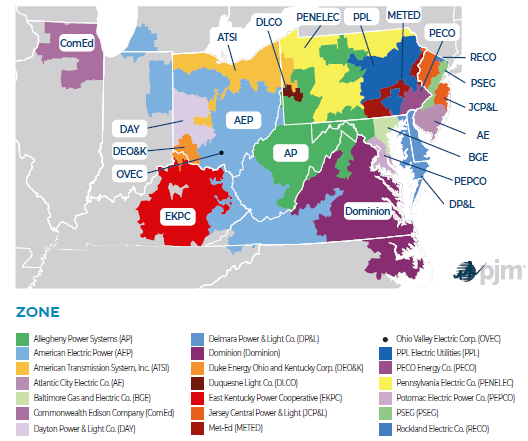
- PJM’s upcoming auctions continue to attract scrutiny from FERC, consumer advocacy groups, PJM Governors’ Collaborative and anybody with an opinion.
- The PJM Independent Market Monitor (IMM) submitted a protest to the Virginia State Corporation Commission and the FERC opposing the Dominion Energy and NextEra Energy combination. The IMM believes the combined entity will have too much transmission and generation under its control, which could work against competitive markets.
NYISO Regulatory Review
- Large-load rules advanced: On October 28, NYISO’s Management Committee approved a proposal addressing large and co-located loads in response to FERC’s show-cause order. The proposal is intended to improve interconnection studies, assign upgrade costs to the loads that cause them, and set operating requirements. Reported provisions include a 50 MW threshold, capacity requirements or possible curtailment, and a non-firm service bid cap.
- The filing deadline is today, November 16: NYISO had planned to seek Board approval and file tariff changes with FERC today. I haven’t found confirmation that the filing has been submitted yet. If NYISO or the transmission owners file, their show-cause responses are suspended while FERC considers the proposal; otherwise, responses are due today.
- Reliability assessment moved forward: On October 28, the Management Committee advanced the 2026 Reliability Needs Assessment. It identifies New York City and Lower Hudson Valley transmission needs beginning in 2032, plus a statewide resource adequacy need beginning in 2033. The draft points to a need for substantial new generation and transmission capability through 2036.
- FERC accepted an interconnection compliance filing: On November 5, FERC accepted NYISO’s compliance filing on interconnection process improvements.
Market Drivers
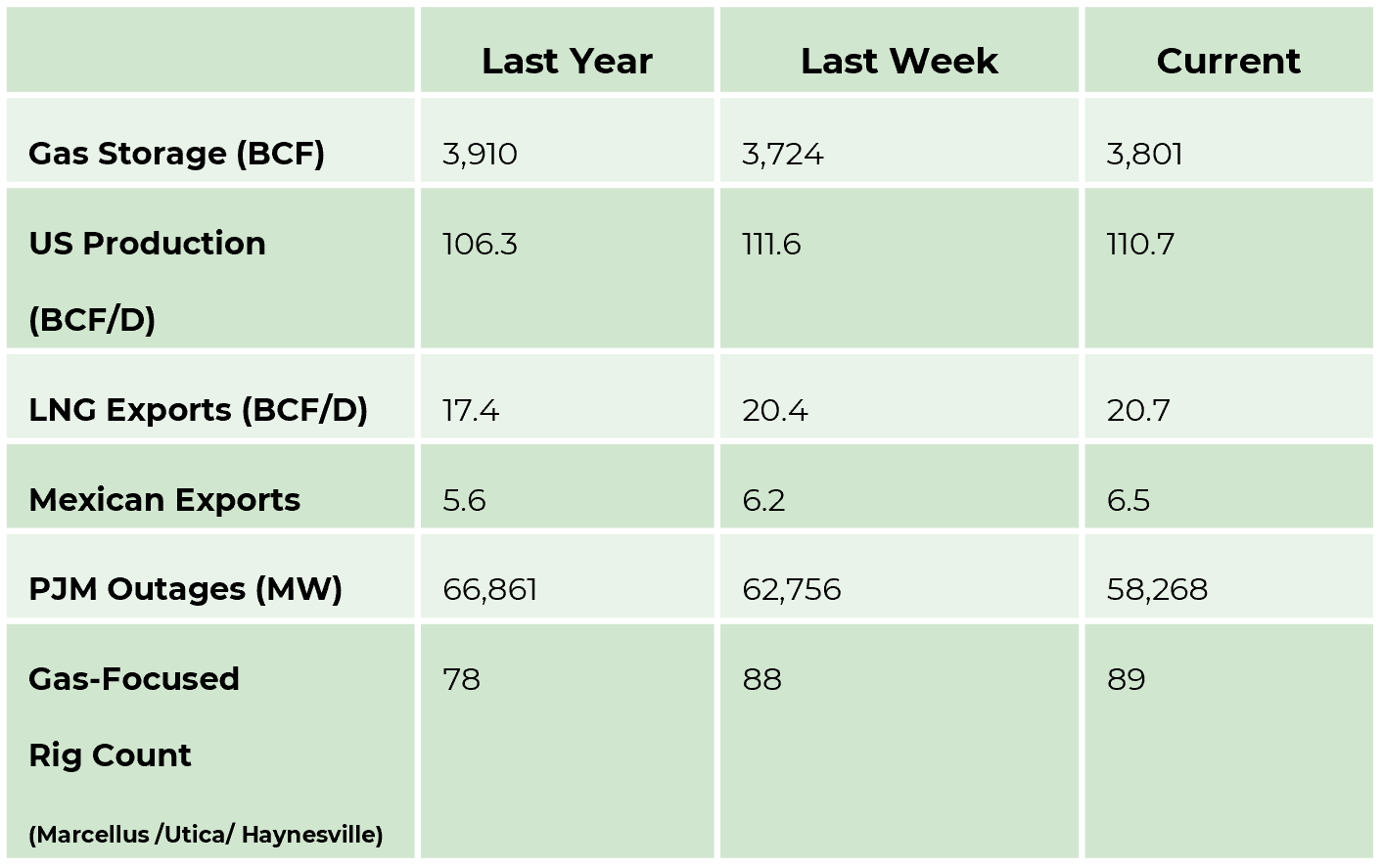
Market Drivers as of November 9, 2026.
- Gas Storage/Year over year difference. A positive number is bearish, and a negative number is bullish.
- Production /Year over year growth/trend is important in the context of demand growth.
- LNG Exports/Year over year growth means demand is growing and should be looked at in comparison to production trend.
- Mexican Exports/Add to LNG Exports to show a trend in exports compared to the production trend.
- PJM Outages- generally seasonal in Spring or Fall/Can support short-term prices.
- Gas Focused Rig Count/Is drilling increasing to grow production versus demand growth. This can be seen as impacting price in the future based on expected load growth.
Energy Market Update
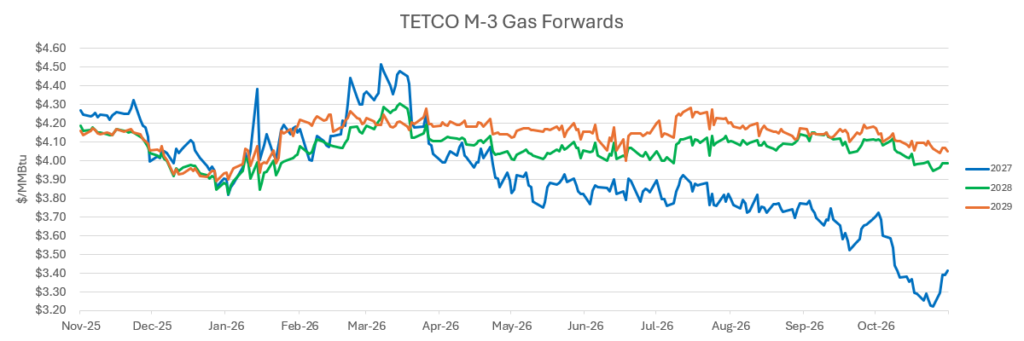
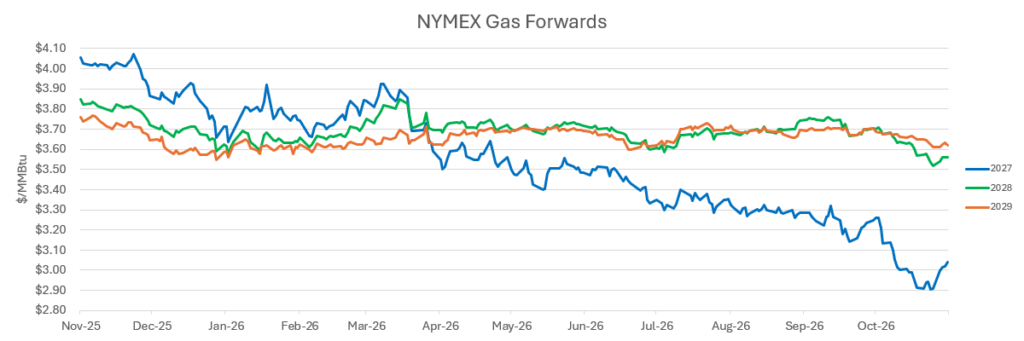
- The “Super El Niño” creating and sustaining warm weather conditions this winter continues to dominate trader conversations and underpin the relentless bearishness in the market.
- The NYMEX traded down to post-COVID lows near $2.5/MMBTU while spot cash prices are barely above $1.0/MMBTU and storage inventories push towards 4 TCF.
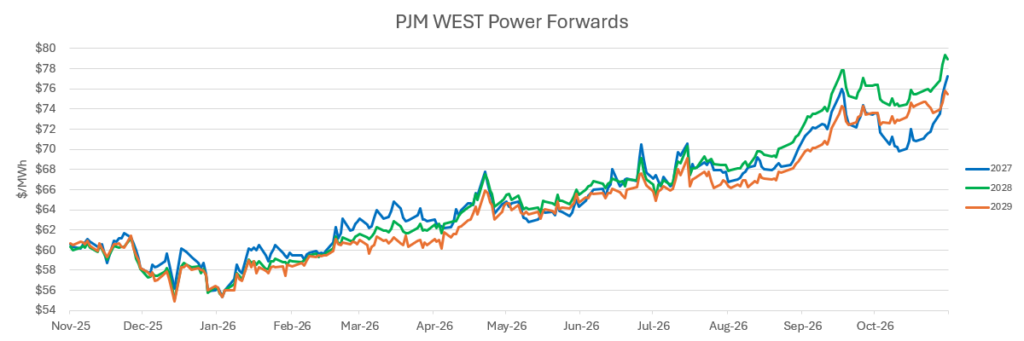
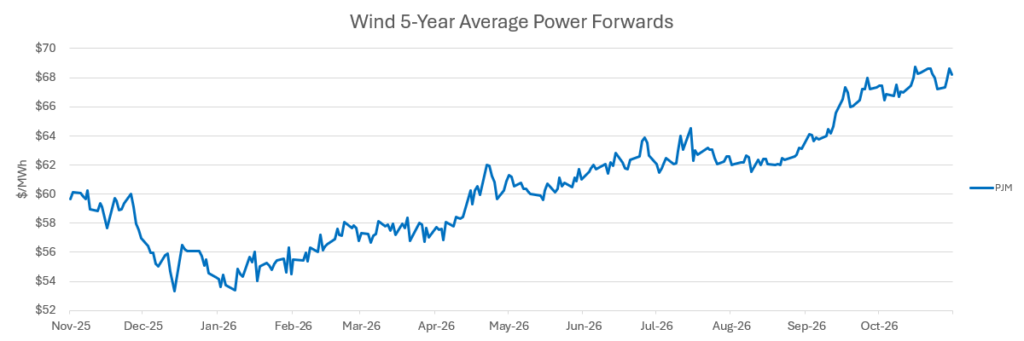
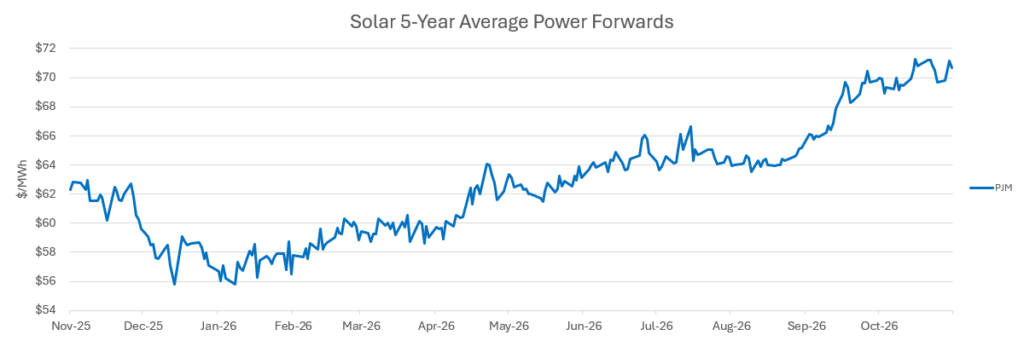
- PJM power prices have remained strong despite weak natural gas prices as the fall maintenance season slowly winds down.
- Producers have reacted to the low spot prices in the Northeast by choking back production, but this mitigant cannot seem to overcome the warm weather, and cash prices remain anchored near $1.00/MMBTU.