August 14, 2026
PJM Reliability Backstop Procurement: What You Should Know
By: Read Comstock, VP, Regulatory Affairs, CPV Retail
- PJM asked FERC for approval to run a one-time Reliability Backstop Procurement (RBP) to address the 6.8 GW capacity shortfall from the auction announced on July 14, 2026.
- If approved, the auction is expected to begin September 30, 2026.
The Problem?
- The basic problem is that electricity demand in PJM is growing faster than new power generation is being built. We know this.
- PJM estimates it needs about 6.8 GW of additional capacity following its latest capacity auction, announced on July 14, 2026.
- The RBP is intended to encourage new generation build and development of other capacity resources by offering developers long-term contracts and more predictable revenue.
These are the two ways PJM plans to secure this new capacity.
- Bilateral Matchmaking: PJM will help connect large electricity users (i.e. data centers) with developers of new generation or other capacity resources. The buyer and seller can negotiate a contract lasting at least five delivery years. Essentially, a large new customer can directly support the new generation needed to serve its electricity demand.
- Central Procurement: PJM will also hold an auction starting September 30. New resources that can be operating by June 1, 2032, can compete for capacity contracts lasting up to 15 years. The costs are intended to reflect areas experiencing significant load growth, including growth associated with large new loads, while the ultimate allocation to customers will depend on state regulatory frameworks and retail structures.
Any capacity secured through bilateral deals before the auction can produce qualifying offsets that reduce the amount PJM needs to procure through the central auction. For example, if bilateral agreements secure 2 GW, PJM would need to procure roughly 4.8 GW of the 6.8 GW target through the auction.
Why is PJM Doing This?
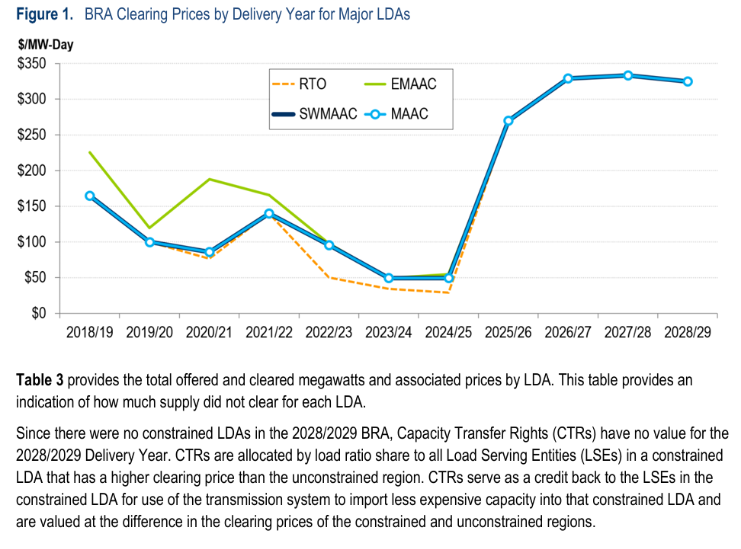
- Capacity prices have risen significantly because electricity demand is rapidly outpacing the ability for new generation to come online.
- The RBP hopes to change that by offering contracts for up to 15 years. That predictable revenue could make it easier to build new generation.
Image Source: PJM